Think of it as AutoStore's cube storage technology, packaged for businesses that don't need a custom-built system. Here's what Pio is, how it works, who it's for and what it costs.
What does Pio stand for?
Pio comes from "Products In and Out", which is a fair summary of what a warehouse does all day. Today it's simply a name, written and said as one word: Pio.
How does Pio work?
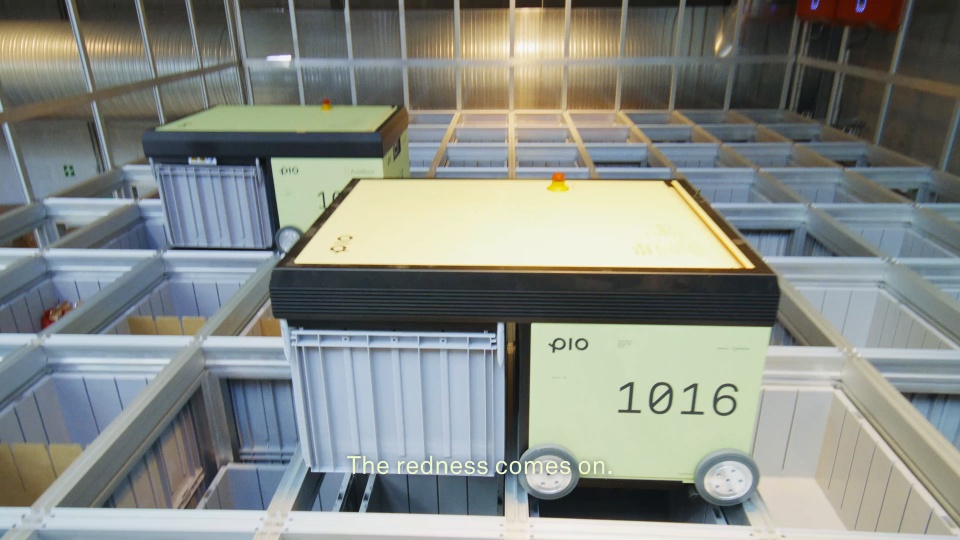
Pio is a cube storage system, a type of automated storage and retrieval system (AS/RS). In plain words: instead of shelves and aisles, your inventory is stored in bins stacked on top of each other in a compact grid.
- Store: products go into bins. Each bin can be split into up to 16 compartments, with one SKU in each.
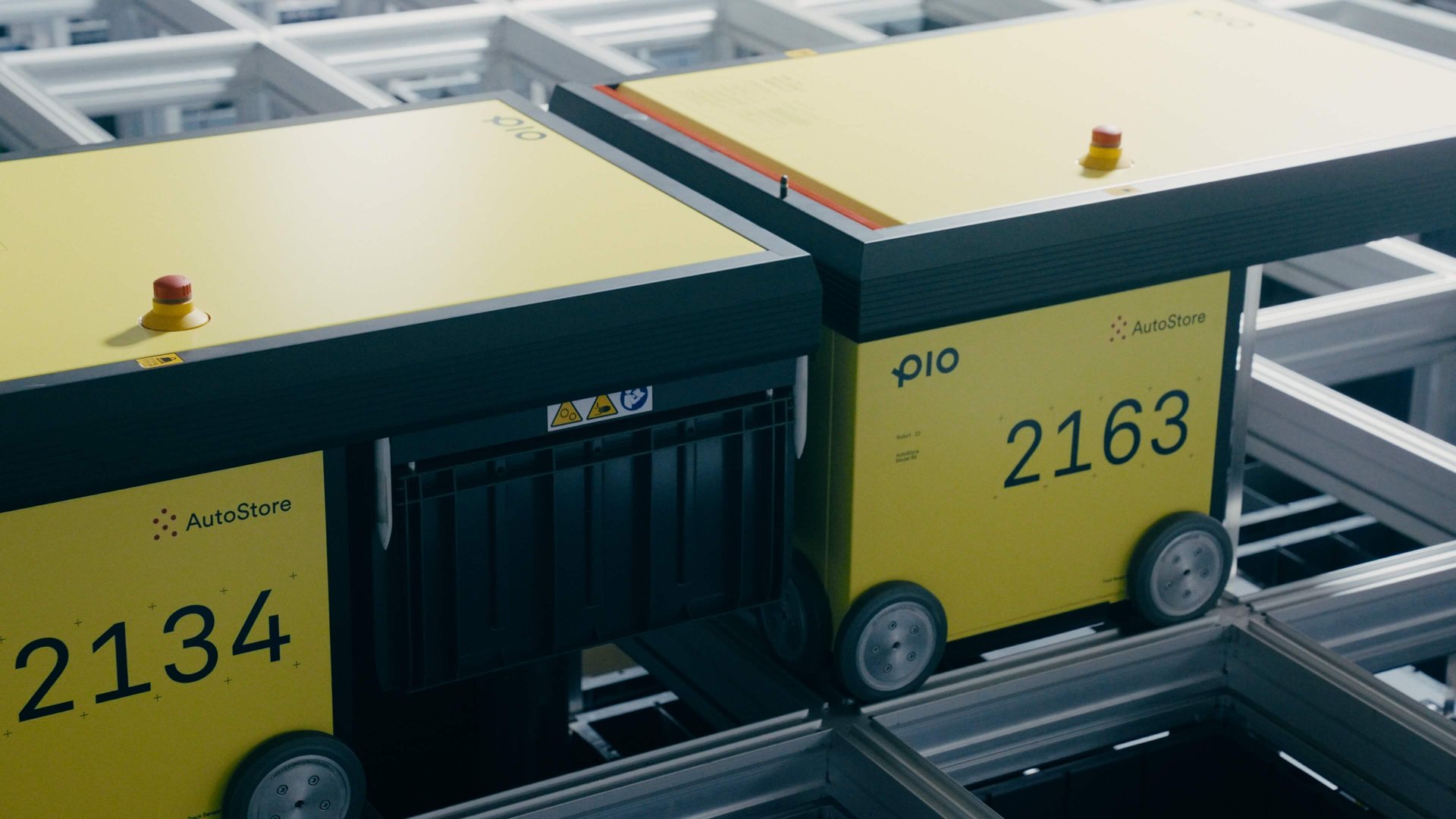
- Fetch: robots drive on top of the grid, dig out the bin you need and bring it to a port.
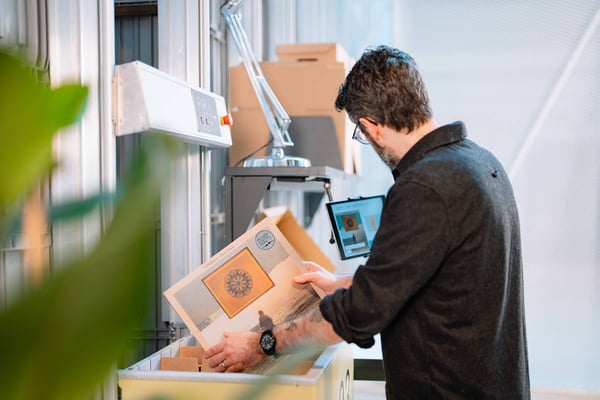
- Pick: someone at the port picks the item, confirms it on screen, and the bin goes back into the grid.
This is called goods-to-person picking: the products come to your team, not the other way around. No ladders, no long aisles, and no searching for the one SKU someone put back on the wrong shelf. See it step by step in how Pio works.
What does the Pio app do?
The robots get the attention, but the Pio app is the brain of the system. It tells the robots where to go, which bin to fetch and where to put it back, so the right products arrive at the port in the right order. It also manages orders and inventory, guides your team through every pick, and tracks every product by name or SKU.
The app connects with the ecommerce platform, ERP, WMS or shipping software you already use, so Pio can run with or without a separate warehouse management system (WMS).
Who is Pio for?
Pio is built for small and mid-sized businesses that are growing faster than their warehouse:
- Ecommerce brands shipping more orders every season from the same space
- Retailers fulfilling in-store and online orders from one inventory
- B2B distributors and wholesalers picking many small parts and SKUs accurately
- 3PLs that need room for new clients without moving buildings
- Manufacturers and industrial businesses storing spare parts and components close to production
What they usually have in common: limited space, a lean team and more orders every year. Pio takes care of storing and fetching, so the team has more time for packing, customers and growing the business.
How is Pio related to AutoStore?
Pio is created by AutoStore, the company that invented cube storage and has more than 1,500 systems installed worldwide. AutoStore designs systems around each operation it serves. Pio takes the same technology and makes it standard: fixed sizes, a quick install and a subscription.
If your business ever outgrows the Pio lineup, you can move to a full AutoStore solution. Read Pio or AutoStore: which system is right for you?
What's in the Pio lineup?
Pio comes in four sizes, and you can move up from one to the next without starting from scratch:
- P100: the compact one, with a 45 m² (484 sq ft) footprint and up to 340 order lines per hour. For small teams getting started.
- P200: for businesses selling through several channels or brands.
- P400: for growing SKU ranges and seasonal peaks.
- P600: the largest standard system, with up to 900 order lines per hour.
On the P400 to P600, Pio Pal adds a robotic picking arm that pre-picks multi-line orders, including overnight. Compare all four in which Pio is right for you.
How much does Pio cost?
A Pio P100 starts from $146,700, plus a monthly subscription from $4,996. The upfront cost covers the hardware and installation. The subscription covers the robots, ports and Pio app on a Robotics-as-a-Service (RaaS) model, which means you rent the robots monthly instead of buying them.
The service level agreement (SLA), local permits, shipping and taxes are priced separately. To see the price for your size and ceiling height, pick your Pio.
What results do Pio customers see?
- Up to 10x more inventory in the same footprint
- Picking up to 5x faster than manual shelving
- 99.9% picking accuracy
- Up to 80% less manual work
- Payback in 12 to 18 months
Getting started is quick too. A standard P100 installs in as little as 5 days, and pickers are trained in as little as 5 minutes. To see what that looks like in a real business, read how Vakre Vene brought fulfillment in-house with Pio, or browse more customer stories.
Where is Pio available?
Pio is distributed, installed and supported by a growing network of certified partners, which makes it available in dozens of countries. They help with layout planning, installation, integration and support, working closely with Pio's in-house team. See all Pio partners.
Frequently asked questions
What is Pio?
Pio is plug-and-play warehouse automation created by AutoStore for small and mid-sized businesses. Inventory is stored in bins in a compact cube grid, and robots bring each bin to a port where your team picks the order.
Is Pio an AutoStore product?
Yes. Pio by AutoStore uses the same cube storage technology as AutoStore, delivered as standardized systems in four sizes with a Robotics-as-a-Service subscription.
What does Pio stand for?
Pio originally stood for "Products In and Out". It's written and said as one word, Pio.
What is the Pio app?
The Pio app is the brain of the Pio system. It controls the robots and decides which bin comes to the port, manages orders and inventory, guides your team through picking, and connects with your ecommerce platform, ERP, WMS and shipping software.
Do I need a WMS with Pio?
Not necessarily. Pio can run without a separate WMS, since the Pio app handles inventory and orders. If you already use a WMS, Pio connects with it.
How much does Pio cost?
A P100 starts from $146,700, plus a subscription from $4,996 a month. The subscription covers the robots, ports and Pio app.
How long does it take to install Pio?
A standard P100 can be installed in as little as 5 days. Larger systems take longer, depending on size.
Does Pio work with Shopify?
Yes. Pio connects with Shopify in minutes, with no coding needed. It also has plug-ins for other platforms and an open REST API for any ecommerce platform, ERP or WMS.
How much space does Pio need?
A P100 has a footprint of about 45 m² (484 sq ft). Standard heights start at 4.3 m (14 ft), and smaller configurations are available on request down to a ceiling clearance of 2.7 m (8.9 ft).
Can Pio grow with my business?
Yes. You can scale up from a P100 to a P600 by adding robots, ports and bins, and scale down again when it's quiet. If you outgrow the lineup, you can move to a full AutoStore solution.
Who installs and supports Pio?
Pio's certified partners install and support the system, together with Pio's in-house team. Your team gets a trained Super User on site who can handle common issues.
Where can I find more answers about Pio?
The Pio FAQ covers everything from bin sizes and robots to power use, returns and integrations.