.webp?width=48&name=Employee-photos--3-2%20(1).webp)



Reducing the space needed for aisles and travel paths allows warehouses to store more inventory before the building is full.
The space you already have
Picture a warehouse operations manager on a Monday morning walk. Orders are up 40% year-on-year. The floor is crowded, people are bumping into each other, and storage locations are maxed out.
More square footage seems like the obvious answer. Then, mid-walk, something shifts.
Above the racking, above the top shelf, above all that activity: empty space. Meters of it, just sitting there.
That's where most warehouse transformations begin. Not with a new lease, but with a change of perspective. The problem isn't the building. It's the layout, which was built around people moving through it. That means a huge chunk of the floor exists purely for movement, not storage. Research backs this up: in manual warehouses, travel eats up to half of total picking time.
In most traditional warehouses, aisles take up a significant portion of the total floor footprint, and they store nothing.
Cube storage changes that.
What is cube storage?
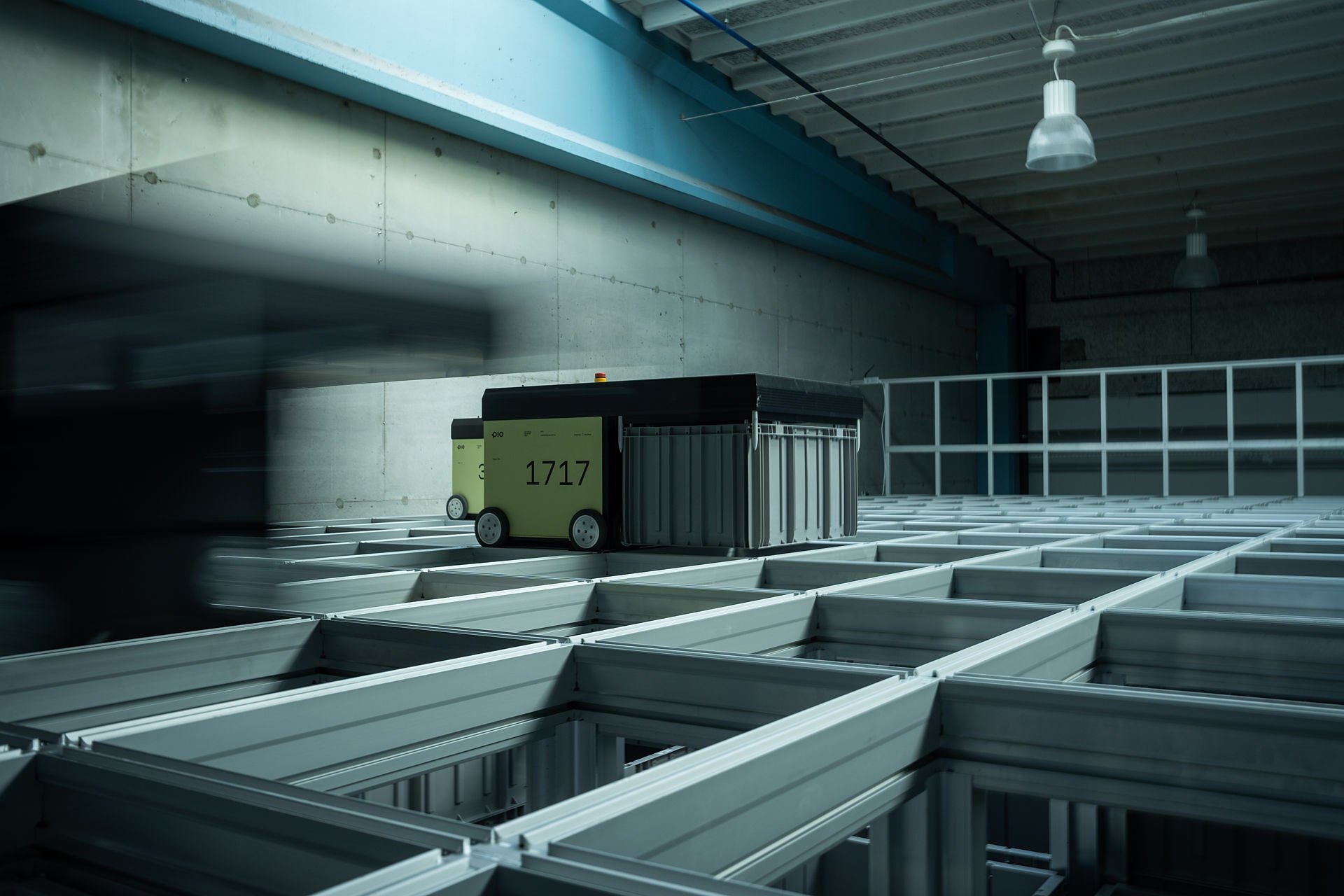
Instead of organizing inventory around workers moving through aisles, cube storage puts products inside a dense, automated 3D grid. Robots retrieve what's needed and bring it directly to workstations.
The technical name is Cube-Based AS/RS (Automated Storage and Retrieval Systems), but the principle is simple: let automation handle movement so more of the building can be used for storage.
Systems likePio, built on AutoStore's cube technology, make this accessible for growing businesses, without the enterprise price tag or the long implementation periods.
Where to look first
Before redesigning layouts or calling a commercial property agent, get a real picture of what the building is actually doing.
Most teams track rack occupancy, but very few track total cubic capacity. Those are different numbers, and the gap between them is usually where the opportunity hides.
Here's a simple way to calculate usable storage volume:
-
Measure your warehouse square footage
-
Measure your usable ceiling height, accounting for sprinklers, lighting, and HVAC (heating, ventilation, and air conditioning systems)
-
Multiply the two
Example: 20,000 sq ft × 24 ft usable height = 480,000 cubic feet of potential storage.
Now compare that against what's actually occupied by inventory. In most warehouses, the answer is uncomfortable. The floor feels full while the overhead space sits empty. That gap is recoverable capacity, and you're already paying rent on it.
Why inventory placement matters
The problem isn't only empty overhead space. It's also where inventory lives relative to how often it actually moves.
Some SKUs ship every day while others barely move for weeks. In most warehouses, fast movers and slow movers end up in similar storage areas because layouts grew organically rather than being planned for efficiency. The result is congestion, wasted travel time, and a warehouse that gets harder to manage the busier it gets.
A useful starting point is building a simple SKU profile:
From there, segment inventory into fast, medium, slow, and long-tail movers. In a traditional warehouse, this mostly helps cut picker travel distances. Useful, but you're still working around the same fundamental constraint.
In a cube-based system like Pio, inventory placement is managed automatically. Software responds to demand in real time, keeping the right products closest to where they need to be. No manual slotting reviews, no guesswork.
Where capacity gets lost
Walk an operation that's struggling to scale and the same culprits tend to appear:
-
Empty overhead space that's never been considered as storage
-
Oversized pick faces for slow-moving SKUs
-
Duplicate SKU locations eating double the space
-
Mixed box dimensions creating awkward gaps in racking
-
Aisle widths designed for forklifts that no longer run there
-
Upper rack levels that are technically reachable but practically ignored
None of these feels catastrophic on its own. Together, they add up to a warehouse that's harder to move through, harder to replenish, and harder to scale without adding headcount or square footage.
There's also a ceiling worth knowing: once a warehouse passes about 85% of its storage capacity, efficiency drops sharply as congestion builds, which is why industry guidance says leave headroom.
Reclaiming that space improves more than just density. It increases throughput, reduces congestion, and makes the whole operation easier to run.
Where Pio fits in
For growing warehouses, the challenge usually isn't finding a better storage concept. It's finding one that's actually implementable, without enterprise-level budgets or a year of downtime. Here's a breakdown of what warehouse automation actually costs.
Built on AutoStore's cube technology, Pio is modular, plug-and-play, and designed to expand as needs grow. For growing businesses, that translates to real, measurable gains:
-
Up to 10x more storage in the same footprint — without moving buildings
-
Up to 99.9% picking accuracy, which means fewer errors and fewer returns
-
Faster picking and packing without adding headcount
-
Installations that take days or weeks, not months
-
Subscription-based pricing for lower upfront costs and predictable spend
-
Scalable capacity with robots and ports added as demand grows
The capacity is probably already there
Think back to that Monday morning walk. The floor was full. The overhead space wasn't. That's where the opportunity was hiding all along.
Cube storage recovers that space by using vertical volume more efficiently and freeing up the floor that movement used to consume.
For growing businesses, systems like Pio offer a more practical path forward: more storage, faster fulfillment, and an operation that gets easier to run as demand grows, not harder. Not sure if you're ready? These 3 signs usually mean it's time.