
Autumn doesn’t just mean pumpkin spice. For warehouses, it is the start of peak season planning. Orders rise, inventory piles up, and fulfillment teams brace for long days. Black Friday and the holidays bring the highest revenue potential of the year and the biggest test for your warehouse.
Peak season success is not just about selling more. It is about whether your operations can keep up without burnout, missed deadlines or unhappy customers. The good news? You do not need enterprise budgets to thrive. You just need smart planning, flexible automation and the right playbook.
Why peak season hits SMBs and 3PLs harder
Big enterprises can throw money and people at the problem. Hundreds of temps, extra space, new equipment. They can absorb the cost of chaos.
Small and mid-sized businesses (SMBs) do not have that luxury. When order volumes double or triple overnight, the strain lands directly on fulfillment. The same team that handles 300 orders a day is suddenly expected to push through 900. Seasonal hires are expensive and often inexperienced. Storage space that already feels tight becomes a game of Tetris.
And yet, customer expectations do not change. They still want next-day delivery. No excuses.
Warehouse worries that keep managers up at night
If you run fulfillment during the holidays, you know the 3 a.m. worries.
- Will the warehouse hold the extra stock, or will pallets spill into the breakroom?
- Can the team handle triple the orders without burning out?
- Will seasonal hires be trained in time, or will errors cost you customers?
- Will your WMS, ERP or ecommerce platform keep up with 10x traffic, or fail mid-Cyber Week?
These are real concerns. And they all point to the same truth: manual processes do not scale.
Start by understanding your peak patterns
You can’t prepare for what you can’t predict. Some businesses peak around the holidays, others spike with monthly promotions, product drops or a viral post. Look at past years: when did order volumes start to rise, how steep was the climb, and how long did the surge last?
Your historical data tells you not just when you’ll need to scale, but how much and how fast. That’s what warehouse flexibility really means: adapting with precision, not panic.
Why warehouse automation wins peak season
Peak season means faster orders, higher accuracy and tighter spaces than most manual processes can handle. Even the best teams can only move so quickly when they are walking aisles, picking from shelves and juggling inventory by hand. The right system helps you:
- Maximize space: store more inventory in less square footage.
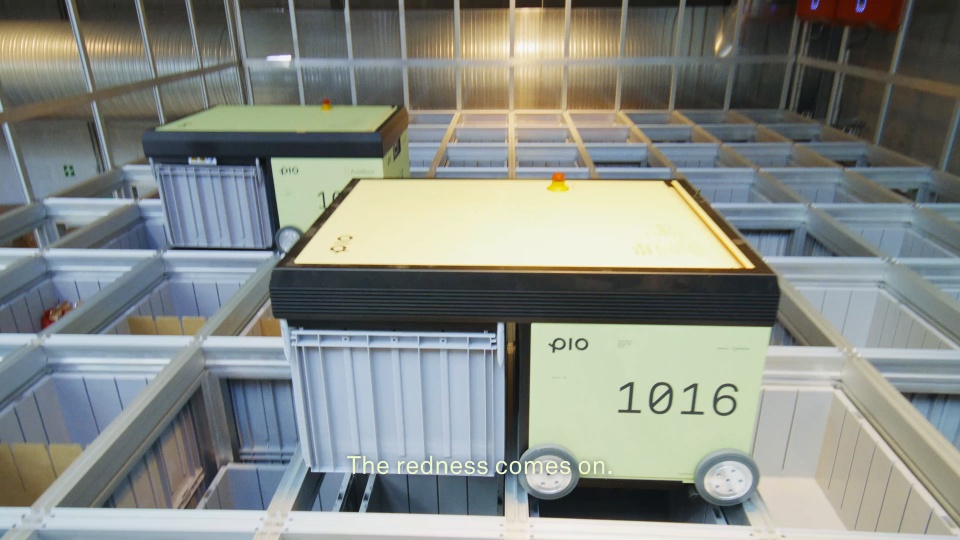
- Boost speed: robots deliver bins straight to the workstation, so your team picks nonstop instead of walking the aisles.
- Increase accuracy: guided picking confirms every step, so the wrong item doesn't end up in the box.
- Stay in control: live dashboards keep you ahead of bottlenecks.
Instead of reacting to every spike, you run a system that scales with you.
Why traditional automation doesn't fit most SMBs
If automation is so powerful, why don't more SMBs use it? Traditional, custom-built systems were designed for large enterprises. They take months to plan and install, need a big budget, and are sized for capacity you may not need all year.
Pio takes a different route: standard sizes, a fixed price, a standard P100 installed in as little as 5 days, and robots you can add when the season calls for it.
How to scale for peaks with Pio
Pio runs on a Robotics-as-a-Service (RaaS) model: an upfront price plus a monthly subscription, so you know your costs from day one. For peaks, you can add booster robots for a minimum of 3 months, then scale back down when the rush is over. More robots mean faster picking, without hiring a single temp.
Most customers see payback in 12 to 18 months, and Dapper did it in about eight. Think about it this way: the cost of a Pio system can be as little as a fancy new company car. But will that car pay for itself in 12 to 18 months, pick 5x faster and give you room to grow? Probably not.
Many SMBs lean on Fulfillment by Amazon (FBA) to get through the holidays. It works in the short term, but fees pile up, flexibility disappears and you lose control over the customer experience.
The real dream team: humans and robots
Pio is not about replacing people. It is about giving them safer, smarter and more rewarding work. Robots handle heavy, repetitive tasks. Humans focus on higher-value work like personalized packing, quality checks and problem-solving.
Fun fact: some of our clients even name their robots. That is how naturally they become part of the team.
How SMBs and 3PLs win peak season with automation
- Souko (3PL): Onboarded two new clients just 2 weeks before Black Friday. With Pio, they preloaded inventory, tripled picking speed and delivered strong service levels through peak.
- Vakre Vene (Retail): Campaign-driven volumes once pushed their team to the limit. Now, orders are picked and shipped before noon, keeping next-day promises even during peak.
- Ko:Ko (Retail): Today, they fulfill volumes that once would have required a much larger team, all while keeping operations smooth.
- Famme (Ecommerce): Black Friday used to mean picking mistakes and canceled orders from overselling. "With Pio, we can focus on selling more, with less errors, less customer service, and less people to manage," says CEO Greg Taube.
Different businesses, same result: peak season becomes an engine for growth instead of a bottleneck.
A peak season planning framework
Break peak into phases and tackle each with control:
- Pre-peak: prepare. Map your peak patterns, forecast demand and preload bestsellers. Use Pio's Replenishment and Stocktake features to spot shortages before they happen, then sync your ecommerce platforms, align suppliers and confirm carrier capacity.
- Ramp-up: scale. Add booster robots, re-slot fast movers and set up Order Filters to sort orders by priority, delivery method or handling time. Use Shelf Pick for bulky items.
- Peak: execute. Monitor dashboards daily, shift people to the busiest ports (the stations where robots bring the bins) and stay on top of returns.
- Post-peak: reset. Review throughput and accuracy, feed lessons into planning and start stronger next year.
Black Friday is your big one? Read how to prepare your warehouse for Black Friday.
Frequently asked questions
How do you handle peak season in a warehouse?
Start with your data: map when demand rises, how fast and for how long. Then prepare inventory early, simplify picking and add capacity where it counts. Automation helps most, because robots bring goods to your team, so picking stays fast and accurate even when volumes triple.
How do you handle a sudden surge in orders?
Prioritize orders by delivery deadline, batch similar orders and keep fast movers close to your pickers. With Pio, Order Filters sort the queue for you, and you can add booster robots for a minimum of 3 months when you know a busy period is coming.
Is warehouse automation worth it for SMBs?
Often, yes. Standard systems like Pio come in fixed sizes and run on Robots-as-a-Service, an upfront price plus a monthly subscription, and Pio customers typically see payback in 12 to 18 months.
How much space can I save with automation?
Cube storage can reduce warehouse space needs by up to 90%, letting you grow without moving facilities.